Quick Answer
- REM sleep is the stage when your brain is highly active and most vivid dreaming happens. Most adults spend roughly a fifth of the night in it, about 90 minutes on a seven-hour night.
- A September 2026 study of 95,559 adults linked more REM sleep to a lower risk of 83 diseases, including dementia and heart failure. It's observational, so it can't prove that more REM lowers risk on its own.
- A steady sleep schedule, less alcohol near bedtime, stress management, and getting sleep problems like apnea checked are the best-supported ways to give REM sleep a fair chance.
About a fifth of your night is spent in a sleep stage most people rarely think about. A study published September 17 in PLOS Medicine suggests it may matter more than anyone realized. Researchers followed 95,559 adults in the UK for almost nine years and found that people who spent more time in REM sleep had a lower risk of 83 different diseases.
That headline has been everywhere this week. Here's what REM sleep is, what the study can and can't tell you, how much you need, and what actually helps.
What Is REM Sleep?
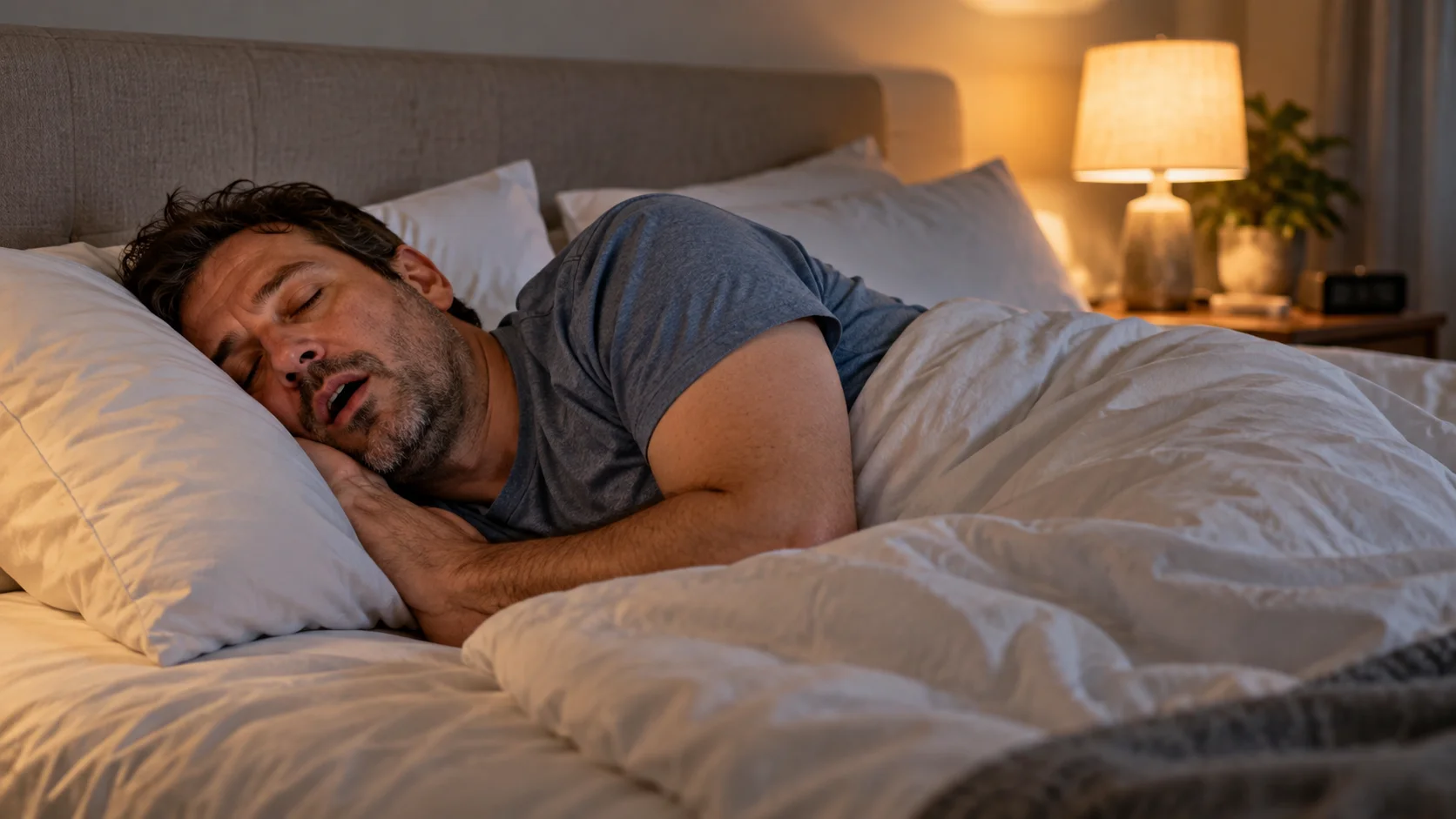
REM stands for rapid eye movement. During this stage, your eyes dart back and forth under closed lids, your brain activity looks a lot like it does when you're awake, and most of your vivid dreaming happens. Your muscles go temporarily limp, a built-in safeguard that keeps you from acting out your dreams.
Researchers think REM sleep helps with learning, memory, and emotional processing. Picture it as your brain's overnight sorting session, where the day's information gets filed. The exact job is still being worked out.
REM vs. Deep Sleep: The Sleep Stages Explained
You cycle through several stages every night, roughly every 90 minutes. Each one does something different:
- Light sleep is the transition zone. It makes up the biggest share of the night, and it's easy to wake from.
- Deep sleep is the most physically restorative stage. Your heart rate slows, and it's much harder to wake you. In the new study, people sleeping six to eight hours spent about 27% of the night here.
- REM sleep is the dreaming stage. Those same sleepers spent about 22% of the night in REM.
REM stretches get longer as the night goes on, so cutting your sleep short tends to cost you REM first.
What the New Study Found
The PLOS Medicine paper is a large observational cohort study. Adults aged 37 to 73 wore a wrist monitor for seven days and nights, and researchers then tracked their health records for a median of 8.9 years, looking at more than 1,000 possible diseases. A computer algorithm estimated each person's sleep stages from their movement.
Research has linked more REM sleep to a lower risk of 83 conditions. Each increase of roughly 48 minutes of REM was associated with a lower risk of dementia (hazard ratio 0.54) and heart failure (0.74), among many others. More deep sleep was linked to a lower risk of seven conditions, including type 2 diabetes and major depression. Sleeping under five hours a night was tied to a higher risk of 37 conditions, while six to eight hours was linked to the lowest risk for most.
Now the caveats, because they matter. This kind of study can't show cause and effect, and other factors may explain some of the links. The authors also point to "reverse causation": depression, for instance, disrupts sleep, so sleep problems may be a symptom rather than the culprit. The same logic may apply to some brain conditions, where sleep changes can show up early. And because the stages came from an algorithm rather than a sleep lab, they're estimates.
The takeaway: REM sleep looks like a marker of healthy sleep overall. Whether boosting it directly would change your risk is a different question, and this study can't answer it.
How Much REM Sleep Do You Need?
There's no official target. In the new study, people in the healthiest sleep range (six to eight hours) spent about 22% of the night in REM, which works out to roughly 90 minutes on a seven-hour night. Individual patterns vary quite a bit, and REM naturally shifts with age.
Don't obsess over the exact number your smartwatch shows. Consumer trackers estimate sleep stages, and they're not as precise as a sleep lab. Total sleep time and consistency are easier to measure and just as useful. Most guidelines recommend at least seven hours for adults, and the study's lowest-risk range fits that.
How to Improve REM Sleep
No hack reliably "adds" REM. But several habits protect the conditions REM depends on: enough total sleep, fewer interruptions, and a steady rhythm.
Keep a regular schedule. In the same study, irregular sleep patterns and more time awake after falling asleep were both linked to higher disease risk. A consistent wake time, even on weekends, is one of the simplest fixes.
Go easy on alcohol near bedtime. This one has the strongest evidence. A 2024 meta-analysis of 27 controlled studies found that alcohol delayed the start of REM sleep and cut its duration, with effects showing up at around two standard drinks and growing with larger amounts. On average, alcohol trimmed REM by about 11 minutes. It may help you fall asleep faster, but it costs you sleep quality later.
Watch caffeine timing. Coffee or energy drinks late in the day can make it harder to fall and stay asleep, and broken sleep means less REM. Many people do better cutting off caffeine by early afternoon.
Manage stress. Ongoing stress can keep your body in an alert state at night. If you suspect it's playing a role, our guides to cortisol testing and chronic stress and the link between stress and tinnitus cover how stress shows up in your body.
Get sleep problems checked. Loud snoring, gasping, or waking up unrefreshed can point to sleep apnea, which repeatedly interrupts sleep. Some medications, including certain antidepressants, can also reduce REM sleep. Don't change a prescription on your own; raise it with your doctor.
Be skeptical of supplements. Magnesium and L-theanine are popular sleep aids, but evidence that they specifically increase REM sleep is limited. Our science-backed sleep supplement stack and guide to magnesium L-threonate and L-theanine break down what research does support for relaxation and sleep quality.
Deep sleep has a metabolic angle worth knowing about too. Since the study linked more of it to lower type 2 diabetes risk, it pairs naturally with our guide to the early signs of prediabetes.
Clinical Evidence at a Glance
| Claim | Evidence Level | What Research Suggests |
|---|---|---|
| More REM sleep is linked to lower disease risk | Large prospective cohort (95,559 adults) | Lower risk for 83 conditions, including dementia and heart failure; observational, so cause isn't proven |
| Higher REM share is linked to lower heart failure risk | Earlier cohort of middle-aged and older adults | Adults with the highest REM percentage had lower rates of new heart failure than those with the lowest |
| Very short sleep is linked to higher risk | Same cohort | Under five hours tied to higher risk of 37 conditions; six to eight hours linked to lowest risk for most |
| Alcohol before bed reduces and delays REM sleep | Meta-analysis of 27 controlled studies | Strong evidence suggests REM disruption begins at about two standard drinks and worsens with dose |
The Bottom Line
The buzz around REM sleep is real, but the science is more measured than the headlines. More REM sleep tracks with better long-term health, yet this study can't say REM itself is doing the work. What it does reinforce is old advice with new numbers: get six to eight hours, keep a regular schedule, and be careful with the nightcap.
Frequently Asked Questions
What is REM sleep?
REM (rapid eye movement) sleep is the stage when your brain is highly active, your eyes move rapidly under closed lids, and most vivid dreaming happens. It's thought to support learning, memory, and emotional processing.
How much REM sleep do you need?
There's no official target. Adults typically spend roughly 20% to 25% of the night in REM, and in the new study, people sleeping six to eight hours averaged about 22%.
How much REM sleep should you get per night?
On a seven-hour night, about 90 minutes is typical. Individual patterns vary, and wearable trackers only estimate REM, so focus on getting enough total sleep and keeping a regular schedule.
What's the difference between REM and deep sleep?
Deep sleep is the most physically restorative stage, with slow brain waves and a slower heart rate. REM sleep is the dreaming stage, when brain activity looks similar to being awake. Deep sleep comes earlier in the night, and REM stretches grow longer toward morning.
How can you improve REM sleep?
Keep a consistent sleep and wake time, limit alcohol close to bedtime, avoid caffeine late in the day, manage stress, and get sleep problems like apnea evaluated. Talk with your doctor if you think a medication is affecting your sleep.
Does more REM sleep lower your risk of disease?
Research has linked more REM sleep to a lower risk of dozens of conditions. But the studies are observational, so they can't prove that increasing REM would lower your risk.
Does alcohol affect REM sleep?
Yes. A meta-analysis of 27 controlled studies found that alcohol delays the start of REM sleep and reduces how much you get, with effects appearing at about two standard drinks.
Are sleep trackers accurate for REM sleep?
They give estimates, not exact measurements. Wearables infer sleep stages from movement and heart rate, so treat REM numbers as a rough guide and watch trends over time rather than single nights.
References
- Luo J, Liu R, Yin J, Cao W, Sun S, Chen R. Accelerometer-derived real-world sleep stages and risk of incident diseases: A UK Biobank cohort study and phenome-wide association analysis. PLOS Medicine, 2026;23(9):e1005213. View study
- Gardiner C, Weakley J, Burke LM, et al. The effect of alcohol on subsequent sleep in healthy adults: A systematic review and meta-analysis. Sleep Medicine Reviews, 2024. View study
- Increased Rapid Eye Movement Sleep Is Associated With a Reduced Risk of Heart Failure in Middle-Aged and Older Adults. View study
- More dream sleep linked to lower risk of 83 diseases, including diabetes. Medical News Today, 2026. View article

The Health Findings Lab Research Team is a dedicated group of health writers, data analysts, and editorial reviewers. Operating under strict, evidence-based editorial guidelines, the team synthesizes peer-reviewed clinical literature to provide objective insights. Our collaborative approach ensures that every review prioritizes verifiable efficacy and manufacturing transparency over marketing hyperbole.