Quick Answer
- Yes, you can take creatine without working out, and it's considered safe for most healthy adults. The best-studied benefits, though, come when it's paired with training.
- In a 2026 trial of 64 adults aged 45 to 65 who weren't exercising regularly, those who took 10 grams of creatine a day gained about 2.4 pounds of lean tissue in 12 weeks and got stronger. Gains were larger in people who also exercised.
- The result comes with caveats: small groups, a dose double the usual one, and a lean-tissue measure that includes water inside muscle. It's an early signal, not proof that creatine replaces exercise.
Adults in a new Texas A&M trial who took creatine and stayed out of an exercise program gained about 2.4 pounds of lean tissue in 12 weeks, compared with placebo.
That's an eye-catching result for anyone who has wondered whether creatine is only for gym regulars. It's also a small study with some built-in limits. Here's what it found, what it can't tell you, and what the wider research says about taking creatine when you're not training.
Can You Take Creatine Without Working Out?
Yes. Creatine isn't a stimulant or a hormone. It's a compound your body makes naturally, and you also get it from meat and fish. Your muscles use it to refuel quickly during short, intense effort, like lifting a heavy box or sprinting for a bus. Think of it as a small backup battery that muscle cells can recharge in a hurry. Supplements raise the amount stored in your muscles.
Athletes made creatine famous, but nothing about it requires being one. The International Society of Sports Nutrition (ISSN) has concluded there's no compelling evidence that short- or long-term use of creatine monohydrate, even at up to 30 grams a day for five years, harms otherwise healthy people.
The open question is how much it does when you aren't training. That's what the new trial set out to test.
What the New Study Found
Researchers at Texas A&M University recruited 73 healthy adults aged 45 to 65 who weren't exercising regularly. Sixty-four finished the 12 weeks, 40 women and 24 men. Each person first chose whether to join an exercise-and-diet weight-loss program or stay in a non-exercise group. Within each group, they were then randomly assigned, without knowing which, to take 10 grams of creatine monohydrate a day (as two 5-gram doses) or a placebo. A DXA scan, a low-dose X-ray that estimates lean tissue, fat, and bone, tracked body composition.
Among people who stayed out of the exercise program, those taking creatine gained about 2.4 pounds of lean tissue and improved their leg press and bench press strength compared with placebo. Muscular endurance improved too.
The exercise group trained with weights and cardio three times a week while eating a modest calorie deficit. Adding creatine led to bigger strength gains and a longer time to exhaustion. Those on creatine gained nearly 3 pounds of lean tissue and lost more body-fat percentage, while the placebo group saw little change in lean tissue. Creatine added nothing for aerobic capacity, which fits with its main job of supporting short bursts of muscle power.
The team also reported favorable changes in some blood fats, in HbA1c (a measure of average blood sugar over a few months), and in some memory and thinking tests among the non-exercisers. The authors describe those individual findings as exploratory, so read them as questions for future research, not conclusions. For what's known about thinking and memory supplements more broadly, see our guide to cognitive supplements for focus and stress.
What the Study Can't Tell You
This was a randomized, placebo-controlled trial, which is a strong design. Several things still limit how far the results stretch.
The groups were small. Reporting on the study noted that only 13 people finished the no-exercise creatine arm. Small groups can produce results that don't hold up in bigger trials.
People chose whether to exercise. Only the creatine-versus-placebo assignment was random. Who ended up in the non-exercise group wasn't, so those people may differ from the exercisers in ways the study can't account for.
Some of the gain may be water. Creatine draws water into muscle cells, and the "lean tissue" a DXA scan reports includes that water. The strength gains suggest something real happened, but some of the extra pounds may be fluid rather than new muscle.
The dose was high. Ten grams a day is about double the 3 to 5 grams most guidelines describe. It's not an established recommendation for everyone.
It was short, and it was narrow. Twelve weeks, in healthy adults aged 45 to 65. The results may not apply to older adults with frailty or to people with health conditions.
One more piece of context. The lead researcher has studied creatine for more than 30 years, and the work was funded by the WoodNext Foundation through the Texas A&M Foundation. That isn't a red flag by itself, but independent confirmation from other labs would add confidence. It's the same lesson we saw in our look at whether collagen peptides actually work: who ran and funded a study can shape how far its results should be trusted.
What Happens If You Take Creatine Without Working Out?
Based on this trial and earlier research, here's a realistic picture.
Your muscles store more creatine. Some people see the scale creep up a bit, mostly from extra water in muscle. In this trial, the lean-tissue gain in non-exercisers was modest: about 2.4 pounds over three months. Strength improved, but less than it did with training. Aerobic fitness didn't improve beyond placebo.
In other words, creatine may give a small head start. It doesn't replace movement.
The evidence is deepest when creatine is combined with training and enough protein. For that side of the equation, see our guides to how much protein you actually need and high-protein diets.
If you're losing weight, keeping muscle matters too. The weight-loss group in this study used diet and exercise, not medication. For what we know about muscle on weight-loss drugs, see our guide to muscle loss on GLP-1 medications.
What About Women After Menopause?
The trial included 40 women and 24 men aged 45 to 65, a range that overlaps with perimenopause and menopause for many women. It didn't focus on them, though. For that, there's a 2026 meta-analysis of seven randomized trials in 608 postmenopausal women, with an average age of about 62.
Strong evidence suggests creatine produces small gains in this group. Lean mass rose by about 0.37 kilograms (roughly 0.8 pounds) and leg-press strength by about 7.5 kilograms compared with placebo. The authors concluded that creatine, particularly at 5 grams a day or more combined with resistance training, yields small but meaningful gains. Bone density didn't change overall, side effects were mild and similar to placebo, and kidney markers were unchanged.
For more on this stage of life, see our guide to menopause and HRT.
How Much Creatine Should You Take?
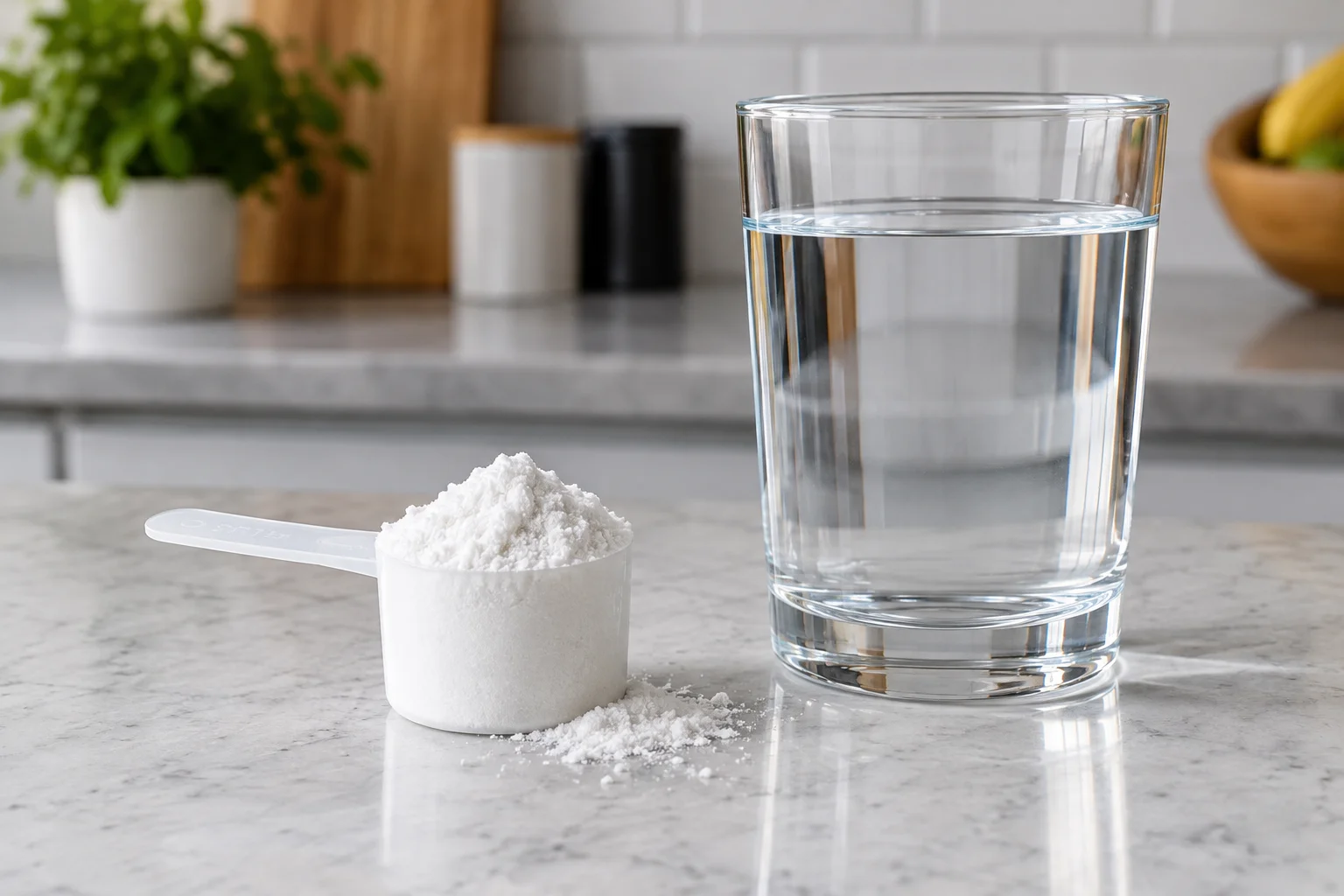
Most research uses creatine monohydrate at 3 to 5 grams a day. You don't need a "loading phase" of higher doses. Taking 3 to 5 grams daily brings muscle stores to full capacity in roughly three to four weeks, a little slower but just as effective.
The new trial's 10 grams a day, split into two doses, is double that. Don't read it as a target. If you're thinking about going above the label dose of any product, talk with your doctor first.
Form matters less than marketing suggests. Creatine monohydrate is the most studied form, and a 2021 ISSN review concluded that the evidence clearly shows it's the optimal choice. Other forms haven't been shown to beat it.
If you'd rather skip mixing powders, one option is Dr. Tobias Creatine Monohydrate (affiliate link), which comes as tablets. The label lists a serving as three tablets with 4.8 grams of creatine monohydrate, 150 milligrams of creatine pyruvate, and 51 milligrams of creatine alpha-ketoglutarate, with 30 servings per container. That works out to about 5 grams of creatine per serving. It's in line with the usual daily dose and roughly half of what the new study used.
The manufacturer markets the two smaller forms for better absorption. Research hasn't shown that any form outperforms monohydrate, and together they add up to about 200 milligrams, a small part of the dose. The label also suggests cycling, meaning 4 to 6 weeks on and 4 to 6 weeks off. Researchers haven't found that cycling is necessary. Whatever you choose, follow the label directions, and look for third-party testing. Our audit of premium supplement brands explains how we judge manufacturing quality.
Is Creatine Safe? Who Should Check First
For healthy adults, the research is reassuring. A 2025 analysis of 685 clinical trials, led by the same Texas A&M research group, found no significant difference in reported side effects between creatine and placebo. The most commonly reported effect in studies is a small gain in body weight, mostly water.
Talk with your doctor before starting if you have kidney disease, take medications that affect your kidneys, or are pregnant or breastfeeding. Also tell your doctor you take creatine before any blood work. It can raise creatinine, a blood marker doctors use to check kidney function, without meaning your kidneys are harmed, and your doctor should know why the number moved.
Clinical Evidence at a Glance
| Claim | Evidence Level | What Research Suggests |
|---|---|---|
| Creatine adds lean tissue and strength in adults who aren't exercising | Randomized, placebo-controlled trial (64 adults aged 45 to 65) | About 2.4 pounds of lean tissue and better leg press and bench press strength over 12 weeks; small groups, and lean tissue includes water |
| Creatine plus exercise and diet adds more | Same trial | Nearly 3 pounds of lean tissue, a bigger drop in body-fat percentage, and larger strength gains than placebo |
| Creatine improves aerobic fitness | Same trial | No added benefit seen |
| Postmenopausal women gain small amounts of lean mass and strength | Meta-analysis of 7 randomized trials (608 women) | About 0.37 kg more lean mass and 7.5 kg more leg-press strength, particularly at 5 grams a day or more with resistance training; no change in bone density |
| Creatine monohydrate is safe for healthy adults | Position stand and review of clinical trials (ISSN) | No compelling evidence of harm in healthy people at up to 30 grams a day for five years; water weight is the most commonly reported effect |
The Bottom Line
Creatine isn't just for gym regulars, and a new trial suggests middle-aged adults who don't exercise may gain a little lean tissue and strength from it. But the result comes from small groups, a high dose, and a measure that includes water, so read it as an early signal. The strongest evidence still favors creatine monohydrate alongside strength training and enough protein. If you try it, stay at the label dose, pick a product with third-party testing (tablet options like Dr. Tobias Creatine Monohydrate exist for people who dislike powders), and check with your doctor if you have kidney problems or take regular medication.
Frequently Asked Questions
Can you take creatine without working out?
Yes. It's considered safe for most healthy adults, and a 2026 trial found lean-tissue and strength gains in adults aged 45 to 65 who took it without exercising. The gains were modest and larger when exercise was added.
What happens if you take creatine without working out?
Your muscles store more creatine, and some people notice a small rise on the scale from extra water in muscle. In the trial, non-exercisers gained about 2.4 pounds of lean tissue in 12 weeks. Aerobic fitness didn't improve beyond placebo.
Does creatine build muscle without exercise?
The evidence is limited. One small trial suggests modest gains, and some of that may be water inside muscle cells. Exercise, especially strength training, produced larger gains.
Should I take creatine if I don't work out?
It depends on your age, goals, and health. For adults 45 and older, the new trial hints at possible benefit, but moving more remains the most reliable way to build and keep muscle. Check with your doctor first if you have kidney problems or take regular medication.
Can I take creatine before bed without working out?
There's no strong evidence that time of day matters for people who aren't training. The trial split its dose into two but wasn't designed to compare times of day. Pick a time you'll stick with.
How much creatine should I take per day?
Most research uses 3 to 5 grams of creatine monohydrate daily, and a loading phase isn't required. The new trial used 10 grams a day, which isn't an established recommendation. Don't go above the label dose without talking to your doctor.
Is creatine monohydrate better than other forms?
A 2021 ISSN review concluded that the evidence clearly shows monohydrate is the optimal choice. Some products pair it with smaller amounts of other forms. That's fine, but those extras haven't been shown to add benefit.
Does creatine come as tablets instead of powder?
Yes. Tablets are more convenient than mixing powder, though cost and the amount per serving vary by product. For example, Dr. Tobias Creatine Monohydrate lists a serving as three tablets with 4.8 grams of creatine monohydrate. Always check the label for the amount per serving.
References
- Chun J, Liu Y, Kibler GL, et al. Effects of creatine supplementation with and without exercise and diet intervention on body composition, cognitive function, and markers of health in middle-aged and older adults. Journal of the International Society of Sports Nutrition, 2026. DOI: 10.1080/15502783.2026.2716273. View study
- Texas A&M University. Study finds creatine's benefits extend beyond the gym (press release, September 18, 2026). View press release
- Naddafha S, Antonio J, Kreider RB, Stout JR. Creatine monohydrate for lean mass, strength, and bone density in postmenopausal women: a systematic review and meta-analysis. Journal of the International Society of Sports Nutrition, 2026. View study
- Kreider RB, et al. International Society of Sports Nutrition position stand: safety and efficacy of creatine supplementation in exercise, sport, and medicine. Journal of the International Society of Sports Nutrition, 2017. View position stand
- Antonio J, et al. Common questions and misconceptions about creatine supplementation: what does the scientific evidence really show? Journal of the International Society of Sports Nutrition, 2021. View review
- People Gained Lean Mass on Creatine Even Without Hitting the Gym. But There's a Catch. ZME Science, 2026. View article

The Health Findings Lab Research Team is a dedicated group of health writers, data analysts, and editorial reviewers. Operating under strict, evidence-based editorial guidelines, the team synthesizes peer-reviewed clinical literature to provide objective insights. Our collaborative approach ensures that every review prioritizes verifiable efficacy and manufacturing transparency over marketing hyperbole.