Introduction
A gummy that promises to out-absorb creatine monohydrate by 59x is either a genuine breakthrough or a marketing claim that got away from the copywriter. We audited EcoWise's Creatine CON-CRET® HCl Gummies against our six-step methodology — label audit, evidence cross-reference, manufacturing check, transparency scan, safety review, and cost-benefit math — to find out which one it is.
This is not a taste test of EcoWise Creatine Gummies. We are not affiliated with EcoWise's formulation team, and nothing below reflects the brand's own marketing copy unless we say so explicitly. Where the label makes a claim, we checked it against the peer-reviewed creatine literature. Where it didn't, we flagged the gap.
What Is EcoWise Creatine HCl Gummies & How Does It Work?
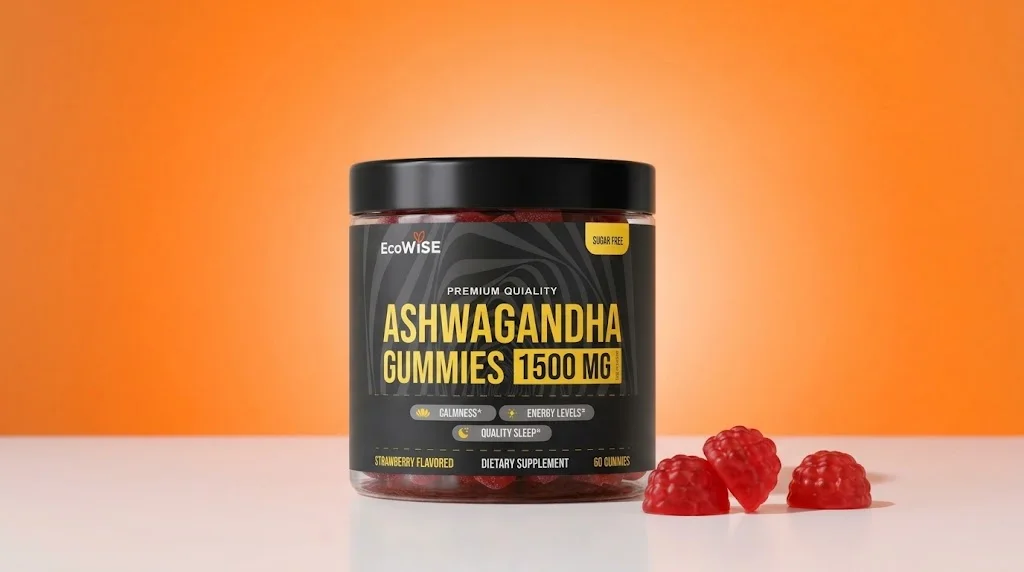
Each serving (3 gummies) delivers 900 mg of CON-CRET® Creatine HCl — a branded, patented creatine hydrochloride salt manufactured by Vireo Systems — alongside a 400 mg turmeric blend (standardized to 95% curcuminoids) and 1.5 mg of black pepper extract (piperine). The product is sugar-free, vegan, and made in the USA, with 30 servings per container.
Creatine itself works by replenishing phosphocreatine stores in muscle tissue, which helps regenerate ATP during short, high-intensity efforts. That mechanism is not in dispute; it's one of the most replicated findings in sports nutrition. What's in dispute is whether the HCl salt form, at this dose, delivers on the absorption claims printed on the sales page.
User Experience & Real Feedback
The sales page cites a 4.9-star average across 50,000+ reviews. We can't independently verify a vendor-hosted review count or filter it for incentivized or subscription-gated reviews, so we treat that figure as marketing context, not evidence. Reading through independent EcoWise creatine gummies reviews on third-party forums and comment threads, the recurring positives are texture and taste (strawberry and mango are the most-mentioned flavors) and the absence of the bloating some users associate with loading-phase monohydrate. The recurring negative, when it shows up, is price relative to a plain powder tub, and some users report not noticing the strength gains they got from a properly dosed monohydrate protocol. That second point tracks with what the dosing math below shows.
Ingredients Analysis (Backed by Science)
CON-CRET® Creatine HCl, 900 mg. This is the headline problem. Every major dosing guideline for creatine — including the International Society of Sports Nutrition's position stand — is built around 3-5 g/day of creatine monohydrate (or roughly 0.03 g/kg/day), following an optional loading phase of 20 g/day for 5-7 days. A 900 mg daily dose of any creatine salt is a fraction of that range. EcoWise's justification is that HCl is dramatically more bioavailable, so less is needed. That claim needs to survive contact with the literature, and it mostly doesn't. Vireo's own patent filings for CON-CRET report a relative bioavailability increase of roughly 50-65% over monohydrate, based on plasma AUC in a small crossover trial — a real number, but nowhere close to "59x more soluble" or "99% absorption vs. 15%." Independent of that patent data, the field's most cited critical review on the topic concludes plainly: no purported form of creatine, salts included, has been shown in peer-reviewed human trials to increase muscle creatine retention or performance beyond what monohydrate achieves at an equivalent dose. That's not our opinion — it's the conclusion of Kreider, Jäger, and Purpura's 2022 critical review in Nutrients, and it echoes what the ISSN position stand already stated in 2017. Even granting CON-CRET's best-case internal number, 900 mg of a 1.5-1.65x more bioavailable salt still delivers less usable creatine than a standard 5 g monohydrate scoop.
Turmeric Blend, 400 mg. The label pools "turmeric root (10:1 extract)" and "turmeric root standardized to 95% curcuminoids" into one combined 400 mg figure, without breaking out how much of that weight is actual curcuminoid content versus inert plant material. To be fair to the brand, this stops short of a true hidden "energy matrix" — the creatine and piperine amounts on this same label are both disclosed down to the milligram, which is more transparency than most gummy competitors offer. The turmeric blend is the one line item where a reader can't fully reconstruct the curcumin dose themselves.
Black Pepper Extract (Piperine), 1.5 mg. The science behind pairing turmeric with piperine is genuinely strong — the foundational human trial found that 20 mg of piperine increased curcumin's bioavailability by roughly 2000% over a short absorption window (Shoba et al., 1998, Planta Medica). The gap is dosing: that study used 20 mg of piperine, and most commercial "BioPerine"-style turmeric stacks target 5-10 mg. At 1.5 mg, EcoWise's formula is dosed at roughly 7-13% of the piperine amount actually tested for that headline 2000% figure. The mechanism is real; the amount on this label is unlikely to reproduce it.
Manufacturing & Quality Signals
The product page displays four credibility badges: SQF certification, "Lab Verified," USA manufacturing, and GMP. SQF (Safe Quality Food) is a legitimate, GFSI-recognized facility certification, GMP compliance is a baseline expectation we look for in every audit, and USA manufacturing is a verifiable, real claim — together these are solid, checkable credentials rather than vague marketing filler. "Lab Verified," on its own, names no lab, no testing standard, and no published certificate of analysis anywhere on the sales page we reviewed, so we'd treat that specific badge as unconfirmed rather than as evidence either way. The one gap worth flagging: the product markets itself to "MMA fighters" and "team sports players," and for that narrower slice of readers who compete under formal anti-doping testing, NSF Certified for Sport or Informed-Sport batch testing would be the relevant seal to look for and isn't present here. For the average gym-goer this distinction matters far less.
Scientific Support & Benefits
Based on the ingredients present and at compliant, non-disease-claim language:
- Creatine (from HCl, even at a sub-clinical dose) may modestly support ATP regeneration during short bursts of high-intensity effort
- Turmeric's curcuminoids are associated with reduced markers of post-exercise inflammation in some human trials, though typically at doses well above 400 mg of a mixed extract
- Piperine may support nutrient absorption when dosed at levels consistent with clinical research
- A sugar-free, gummy delivery format may support consistency of use for people who reliably skip chalky powder scoops
Safety & Possible Side Effects
Creatine HCl carries the same broad safety profile as monohydrate — well tolerated in healthy adults, with gastrointestinal upset being the most commonly reported issue at high doses (not a concern at 900 mg). Turmeric and piperine are both generally recognized as safe in food-level amounts; piperine can modestly increase the absorption of certain medications, so anyone on prescription drugs metabolized through CYP3A4 (including some statins and blood thinners) should flag this product with their physician before use. One structural point worth flagging: creatine is chemically unstable in moist, low-pH environments and gradually converts to inactive creatinine over time — a phenomenon documented in gelled and liquid creatine formulations, where degradation of up to 90% has been measured within 45 days under certain storage conditions (stability study, Journal of Pharmaceutical and Biomedical Analysis). EcoWise does not publish shelf-stability or creatinine-content testing data for the finished gummy, so we can't confirm how much active creatine actually remains in a gummy pulled from the bottom of a bottle three months in.
Editorial Scorecard: How We Calculated the Rating
Per our published methodology, the Editorial Rating is the exact weighted average of five sub-scores. Nothing here is rounded up for the sake of a "nicer" number.
| Pillar | Score | Weight |
|---|---|---|
| Formula Quality | 2.2/5.0 | 30% |
| Scientific Evidence | 2.0/5.0 | 25% |
| Manufacturing & Safety | 4.0/5.0 | 20% |
| Transparency | 3.3/5.0 | 15% |
| Value | 1.8/5.0 | 10% |
| Final Score | 2.6/5.0 | 100% |
Formula Quality — 2.2/5.0. A 900 mg creatine HCl dose is a fraction of the 3-5 g/day range that decades of creatine research is built on — even applying CON-CRET's own best-case bioavailability multiplier only gets you to roughly 1,485 mg of "effective" creatine, still well short of the clinical minimum. We credit the formula for at least itemizing its two turmeric sources rather than hiding them behind a single unnamed matrix.
Scientific Evidence — 2.0/5.0. The brand's "59x" and "99% absorption" claims dramatically exceed even the manufacturer's own patent-filed bioavailability data (roughly a 50-65% increase), and independent reviews have found no creatine salt outperforms monohydrate in actual muscle retention or performance outcomes. There is a real human pharmacokinetic trial behind the ingredient — it's being overstated, not fabricated.
Manufacturing & Safety — 4.0/5.0. USA manufacturing, SQF certification, and a stated GMP facility are real, independently verifiable credentials that most competitors in this category don't bother to disclose. The one deduction is the absence of NSF Certified for Sport or Informed-Sport batch testing, which only matters to the subset of readers competing under formal anti-doping rules.
Transparency — 3.3/5.0. Creatine and piperine doses are both disclosed to the exact milligram — this is not a hidden proprietary blend by the standard our methodology penalizes most harshly. The deduction is narrower than we initially scored it: the combined 400 mg turmeric figure and the absence of a linked certificate of analysis are the only real gaps.
Value — 1.8/5.0. Cost per gram of active creatine still runs several times higher than a plain monohydrate powder delivering the full clinically supported 5 g/day dose, though the 30-day money-back guarantee does meaningfully lower the risk of testing it yourself.
Who Should Consider / Who Should Avoid
Consider it if: you're creatine-naive, prioritize adherence and taste over maximizing muscle creatine saturation, and are comfortable paying a premium for convenience rather than clinical dose-matching.
Avoid it if: you're a competitive athlete who needs third-party banned-substance testing, you're already taking a properly dosed 3-5 g/day monohydrate protocol and don't want to downgrade the dose, or you're on medication metabolized via CYP3A4 and haven't cleared piperine with your doctor.
Women exploring creatine specifically around perimenopause or menopause for its emerging research on bone density, mood, and lean mass should also read our dedicated breakdown of the clinical data before choosing a product: Creatine for Women in Menopause: What the Clinical Research Actually Shows.
Alternatives & Comparisons (The Editorial Verdict)
If your goal is maximizing muscle creatine saturation on the evidence we actually have, a plain creatine monohydrate powder — ideally Creapure-certified for purity — dosed at 3-5 g/day remains the gold standard the entire industry is still measured against. It's not exciting, it doesn't come in mango flavor, and it will outperform this product's active dose on paper every time. If the trade-off you're making is convenience and palatability over maximum dosing precision, and you've read the gaps above and are still comfortable with them, EcoWise's format and manufacturing credentials are at least legitimate rather than fabricated — the issue is the marketing math on the label, not the existence of a scam.
Pricing & Money-Back Guarantee
EcoWise lists a one-time purchase price of $166 for a two-pack bundle, discounted to $113, with a Subscribe & Save option bringing it to $83 (roughly $41.50 per 30-serving container) shipped every two months. At 900 mg/day, that works out to somewhere around $1.35-$1.60 per day for an under-dosed creatine serving — several times the daily cost of a properly dosed monohydrate scoop. The listed 30-day money-back guarantee is a genuine value-add if you want to test tolerance and taste without long-term commitment. You can review current pricing and the guarantee terms directly here: check current EcoWise pricing and the 30-day guarantee.
Frequently Asked Questions
Are EcoWise creatine gummies legit?
The company and the CON-CRET branded ingredient are both real, and the manufacturing credentials (USA-made, GMP, SQF) check out. "Legit" doesn't mean the marketing math is accurate, though — the specific bioavailability multipliers on the sales page go well beyond what's supported in the peer-reviewed literature or even the ingredient's own patent data.
Is EcoWise creatine good?
As a creatine source, it's real CON-CRET HCl rather than a filler ingredient, which is a point in its favor. As a dosing strategy, 900 mg/day falls well short of the 3-5 g/day range most human performance studies are built on, so "good" depends heavily on what you're using it for.
Are EcoWise creatine gummies third-party tested?
The sales page uses a "Lab Verified" badge but does not name the testing lab, the standard used, or link a certificate of analysis. There is no visible NSF Certified for Sport or Informed-Sport seal, which is the specific third-party testing competitive athletes typically look for.
Final Verdict
EcoWise didn't fabricate an ingredient or hide a proprietary blend behind ten unlisted compounds, and the manufacturing credentials behind it are genuinely solid — that combination keeps this out of scam territory. What holds it back is a real, patented creatine salt with modest, patent-documented bioavailability advantages, marketed with absorption multipliers that don't survive a literature check, at a dose that's a fifth of what clinical research actually uses. The turmeric-piperine pairing is scientifically sound in principle and underdosed in practice. If you want the convenience of a gummy from a legitimately manufactured brand and you've read the gaps above with open eyes, the 30-day guarantee makes trial low-risk: see current EcoWise pricing and try it risk-free. If your priority is dose-matched, evidence-backed creatine supplementation, a plain monohydrate scoop still does more for less.

The Health Findings Lab Research Team is a dedicated group of health writers, data analysts, and editorial reviewers. Operating under strict, evidence-based editorial guidelines, the team synthesizes peer-reviewed clinical literature to provide objective insights. Our collaborative approach ensures that every review prioritizes verifiable efficacy and manufacturing transparency over marketing hyperbole.