Quick Answer
- "Ozempic face" describes hollowed cheeks, sunken temples, and sagging skin that can appear after rapid weight loss on GLP-1 drugs like semaglutide and tirzepatide. It's a real, documented pattern, not internet rumor.
- Researchers describe two causes: fast loss of facial fat, and a newer, still-developing theory that these drugs may also affect collagen-producing cells in the skin directly.
- Slower weight loss, adequate protein and hydration, and resistance training are the modifiable factors dermatology research links to milder changes. Dermal fillers are the most common clinical treatment for people already affected.
An estimated 31 million American adults were taking a GLP-1 drug as of late 2025, according to KFF Health Tracking Poll data — roughly 12% of the adult population, up from 6% just eighteen months earlier. As the number of people losing significant weight on semaglutide and tirzepatide has climbed, so has a side effect nobody put on the drug label: a distinctly aged look in the face.
Dermatologists have a name for it now. Here's what the research actually says about why it happens, who it happens to, and what can be done about it.
What Is Ozempic Face?
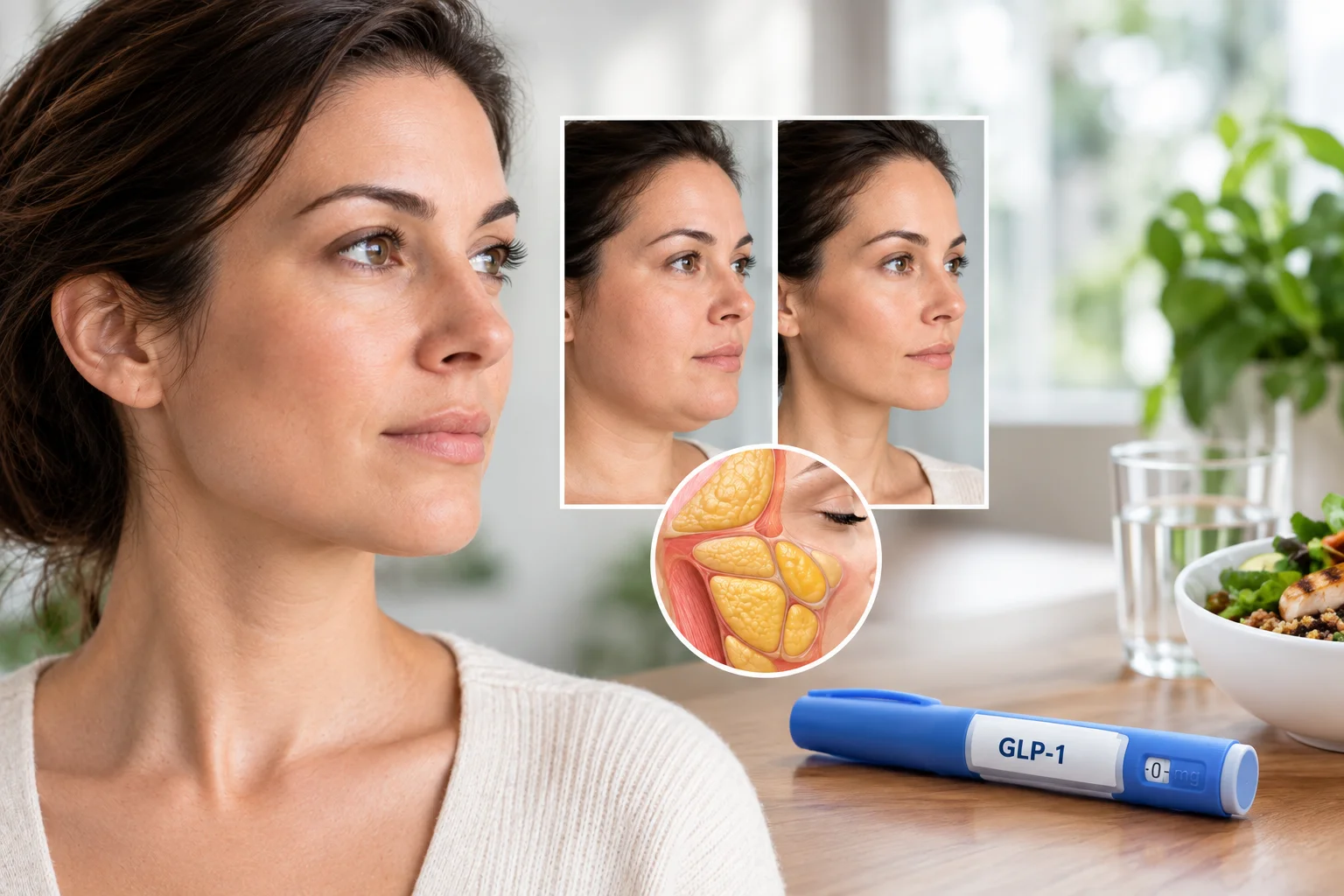
Ozempic face is the term clinicians and patients use for a specific pattern of facial changes that can follow rapid, significant weight loss on GLP-1 receptor agonist medications. It includes hollowed cheeks, sunken temples, deepened nasolabial folds (the lines running from nose to mouth), under-eye hollowing, and skin that looks looser or more crepey than before treatment.
The name references Ozempic specifically because it was the first GLP-1 drug to become a household name, but the pattern has been reported across the whole drug class, including Wegovy, Mounjaro, and Zepbound.
Is Ozempic Face Real?
Yes. It's not a myth or a media invention. A 2026 Google Trends analysis published in a peer-reviewed journal tracked search interest in "Ozempic face" alongside related terms like "face filler" and found the two rose together, which lines up with what dermatology and plastic surgery clinics are reporting directly. In a December 2025 survey by the American Academy of Facial Plastic and Reconstructive Surgery, 67% of member surgeons said they'd seen an increase in patients seeking treatment for weight-loss-related facial changes — a 45% jump from the year before. The same survey found a 50% increase in facial fat grafting procedures for the second year running.
What's genuinely still being worked out is why it happens and whether it's simply fat loss or something more.
What Causes It: Two Mechanisms, Not One
Mechanism one: fast, significant fat loss. Your face carries small, distinct pockets of fat — mainly in the cheeks (malar area), temples, and under the eyes (infraorbital area) — that give it a full, youthful shape. GLP-1 drugs cause weight loss throughout the body, including these facial fat pads. Lose that volume quickly, and the skin that was stretched over it doesn't have time to shrink back down to match. The result is a hollowed, deflated look rather than a smooth, evenly slimmer face.
The three facial fat compartments most affected: temporal (temple), malar (cheek), and infraorbital (under-eye).
Mechanism two: a possible direct effect on skin cells. A 2026 review in the Journal of Cosmetic Dermatology proposes that fat loss may not be the whole story. GLP-1 receptors sit on the surface of fibroblasts (the cells that build collagen and elastin) and adipose-derived stem cells in the skin. Laboratory research suggests that activating these receptors may reduce those cells' ability to produce protective, structural proteins — potentially degrading collagen and elastic fibers in the dermis independent of fat loss. This is an early hypothesis based on lab and biopsy research, not a settled fact, but it would help explain why some patients see more skin laxity than fat loss alone predicts.
What It Looks Like
Based on the clinical and dermatology literature, the changes most commonly described are:
- Hollow, flattened cheeks where fullness used to sit
- Sunken temples
- More visible under-eye hollows and dark circles
- Deeper nasolabial folds and marionette lines
- Looser skin along the jawline, sometimes read as new jowling
- A generally "older" or "tired" appearance that seems out of proportion to actual age
Plastic surgeons also report that these changes aren't confined to the face. The same rapid-volume-loss pattern has been described in the abdomen, breasts, and upper arms, showing up as loose or sagging skin after substantial weight loss.
Does It Go Away?
Not usually on its own, at least not the volume component. Facial fat pads don't reliably refill once weight stabilizes, so the hollowing tends to persist unless it's addressed directly. Skin elasticity can improve somewhat over months as tissue remodels, but severe volume loss generally needs a clinical intervention to visibly correct. This is one of the reasons dermatology researchers are pushing for prevention-focused strategies started early in treatment, rather than waiting to react after the fact.
Who Seems More Affected — and What You Can Influence
A 2026 review identified several factors linked to more noticeable changes:
- Older age — thinner baseline skin with less capacity to remodel and tighten
- A longer history of carrying excess weight — skin that's been stretched longer has less elastic "snap-back"
- How fast the weight comes off — rapid loss leaves less time for skin and connective tissue to adjust
- Hydration and protein intake — both affect skin quality independent of GLP-1 use, and inadequate intake appears to make outcomes worse
That last point connects directly to two things covered elsewhere on this site: eating enough while on GLP-1 medication despite reduced appetite, and the broader question of preserving lean muscle during treatment. Adequate protein supports skin structure the same way it supports muscle — and losing weight more gradually, where medically appropriate, is one of the few levers patients and prescribers can actually pull. For a comparison of pacing, see our guide to sustainable, non-pharmaceutical weight loss.
How Dermatologists Approach Prevention and Treatment
A 2026 paper in Aesthetic Plastic Surgery proposed one of the first structured, anatomy-based frameworks for this problem, focused on identifying patients at higher risk for facial volume loss before it becomes severe, rather than only offering correction afterward.
In current practice, the most common treatment is hyaluronic acid-based dermal filler, used to restore lost volume in the cheeks, temples, and under-eye area. Some clinics also use facial fat grafting — transferring fat from elsewhere in the body — which the AAFPRS survey noted has become more common as this issue has grown. Neither approach is something to pursue without a consultation; results, safety, and cost vary by provider and individual anatomy, and this is a decision to make with a board-certified dermatologist or plastic surgeon.
On the prevention side, the same research points to the modifiable factors listed above: pacing weight loss where clinically reasonable, prioritizing protein and hydration, and maintaining resistance training, which supports both muscle and the tissue quality underneath skin.
Clinical Evidence at a Glance
| Claim | Evidence Level | What Research Suggests |
|---|---|---|
| Ozempic face is a real, documented phenomenon | Survey data + infodemiologic study | 67% of surveyed facial plastic surgeons report increased patient demand; search trends for the term track closely with clinic-reported cases |
| Caused primarily by facial fat loss | Clinical observation, anatomy-based review | Well supported — matches known fat compartment anatomy and rapid weight-loss patterns |
| GLP-1 drugs may directly affect skin collagen | Lab and biopsy research | Early-stage hypothesis; GLP-1 receptors found on skin fibroblasts and stem cells, but not yet confirmed in large human trials |
| Slower weight loss reduces severity | Clinical review, expert consensus | Considered a modifiable risk factor, though not yet tested in controlled trials |
| Dermal fillers restore lost volume | Clinical practice data | Standard, widely used approach; individual results vary and require a qualified provider |
The Bottom Line
Ozempic face is a real, increasingly documented side effect of rapid weight loss on GLP-1 medications, not internet exaggeration. The clearest driver is fast loss of facial fat outpacing the skin's ability to adjust; a second, less-settled theory suggests these drugs may also affect the skin's own collagen-producing cells. Neither should be a reason to avoid a medication that, for many patients, delivers real metabolic and cardiovascular benefits — but it's worth discussing pacing, protein intake, and hydration with your prescriber, and knowing that dermal fillers are the established option if facial volume loss becomes a concern worth addressing.
Frequently Asked Questions
What is Ozempic face?
It's the term for hollowed cheeks, sunken temples, deeper facial lines, and looser-looking skin that can develop after rapid weight loss on GLP-1 medications like Ozempic, Wegovy, Mounjaro, and Zepbound.
Is Ozempic face real?
Yes. Survey data from facial plastic surgeons and search-trend research both confirm it as a recognized, growing clinical pattern, not a media myth.
What causes Ozempic face?
Primarily fast loss of the small fat pads that give the face its shape. A second, still-developing theory suggests GLP-1 drugs may also act directly on skin cells that produce collagen, though this hasn't been confirmed in large human trials.
What does Ozempic face look like?
Common features include hollow cheeks, sunken temples, deepened nasolabial folds, under-eye hollowing, and skin along the jawline that looks looser than before weight loss.
How can you avoid or prevent Ozempic face?
Research points to pacing weight loss more gradually where medically appropriate, getting enough protein and staying hydrated, and keeping up resistance training. None of these are guarantees, but they're the modifiable factors current research has identified.
Does Ozempic face go away on its own?
Usually not fully. Lost facial fat volume doesn't reliably return once weight stabilizes, though skin quality can improve somewhat over time. Most people who want visible correction pursue a clinical treatment like dermal filler.
What treats Ozempic face?
Hyaluronic acid-based dermal fillers are the most common approach, used to restore volume in the cheeks, temples, and under-eye area. Facial fat grafting is another option some clinics offer. Both require a consultation with a board-certified provider.
Does stopping the medication reverse it?
There isn't strong evidence that stopping a GLP-1 medication reverses facial volume loss on its own, since the fat pads themselves have diminished rather than just shrunk temporarily. Any decision about starting, adjusting, or stopping a GLP-1 medication should be made with your prescribing doctor, not based on cosmetic concerns alone.
References
- Feng et al. GLP-1 Receptor Agonists and Facial Aging: Two Overlooked Mechanisms. Journal of Cosmetic Dermatology, 2026. View study
- GLP-1RA and the possible skin aging. View study
- Castrellon R, Maita K, Witt E, et al. Preventing GLP-1-Associated Facial Aging: An Anatomy-Driven Risk Stratification Model and Prevention Algorithm in the "Ozempic Face" Era. Aesthetic Plastic Surgery, 2026. View study
- Rising Public Interest in Weight Loss Medications and Growing Awareness of Their Aesthetic Sequelae: An Infodemiologic Google Trends Analysis. View study
- GLP-1 Drugs: Is Ozempic Face Changing Aesthetic Care? Medscape, 2026. View article

The Health Findings Lab Research Team is a dedicated group of health writers, data analysts, and editorial reviewers. Operating under strict, evidence-based editorial guidelines, the team synthesizes peer-reviewed clinical literature to provide objective insights. Our collaborative approach ensures that every review prioritizes verifiable efficacy and manufacturing transparency over marketing hyperbole.