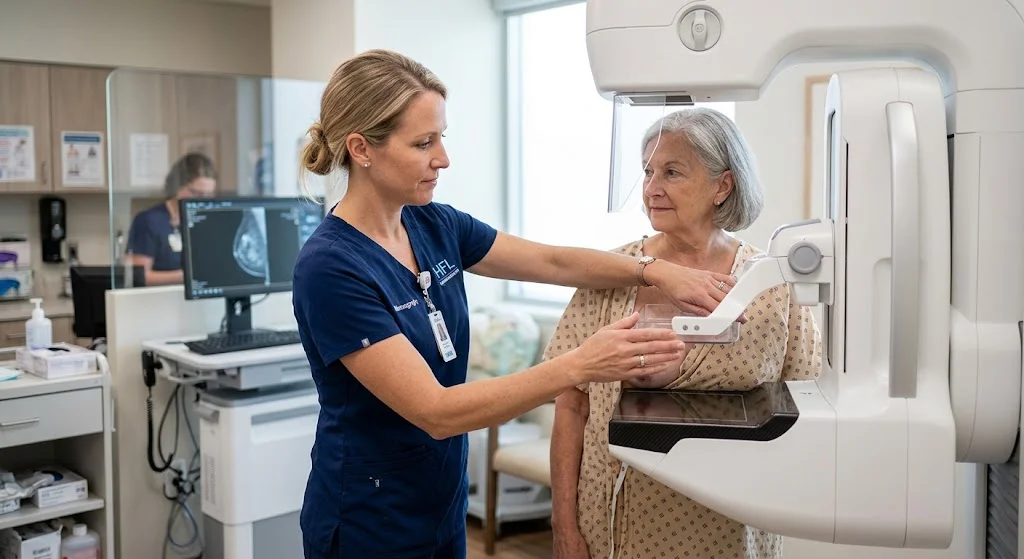
Quick Answer
- For women at average risk, the U.S. Preventive Services Task Force recommends a mammogram every two years from age 40 to 74. The American Cancer Society says yearly from 45 to 54, with the option to start at 40. The two guidelines differ, so the right schedule is a conversation with your doctor.
- A September 2026 reanalysis of all eight major randomized mammography trials found results consistent with overdiagnosis below 5%, far lower than older estimates of 30% to 50%. It's a reanalysis, not a new trial.
- A 2026 trial of nearly 100,000 German women found that 3D mammography caught more cancers at the screening visit. Its 24% lower rate of cancers found between screenings wasn't statistically significant, and the trial can't say whether 3D saves more lives.
For years, you may have heard that up to half of the breast cancers found by mammograms are ones that would never have caused harm. A new analysis says that number is probably far too high.
That finding landed within weeks of another one: a large trial that put 3D mammography head to head with the standard 2D version. Both studies matter for anyone deciding when to start screening and how often. Here's what each one shows, what it can't prove, and what current guidelines say.
What the Guidelines Say Right Now
The two main U.S. guidelines for women at average risk agree on the basics and differ on timing.
The U.S. Preventive Services Task Force (USPSTF), an independent expert panel, recommends a mammogram every two years for women aged 40 to 74. That's a grade B recommendation, which means the panel found a moderate net benefit with moderate certainty. It found enough evidence that screening has a moderate benefit in reducing breast cancer deaths, and that the harms are small. For women 75 and older, it says there isn't enough evidence to recommend for or against screening.
The American Cancer Society (ACS) takes a slightly different path. Women 40 to 44 have the option to start yearly mammograms. Women 45 to 54 should get one every year. From 55 on, women can switch to every other year or keep going yearly, for as long as they're in good health and expected to live at least 10 more years. The ACS also says clinical breast exams aren't recommended for average-risk women at any age.
Both guidelines apply to women at average risk. A personal history of breast cancer, a strong family history, or a gene change such as BRCA puts a woman in a different category. For high-risk women, the ACS recommends a yearly breast MRI plus a mammogram, typically starting at age 30. If any of that sounds like you, ask your doctor for a personal plan.
What Is Overdiagnosis?
Overdiagnosis is one of the main downsides of screening. It happens when a mammogram finds a cancer that would never have caused symptoms or threatened a woman's life.
The tricky part is that nobody can tell, in the moment, which cancers those are. A woman might go her whole life without that cancer causing a single problem. But once it's found, doctors can't safely assume it will stay harmless, so she may go through treatment she didn't need.
Ductal carcinoma in situ (DCIS) is the classic gray area. It's a group of abnormal cells contained inside the milk ducts. Some cases can progress to invasive cancer, while others may never become dangerous.
What the New Analysis Found
For decades, researchers have argued over how common overdiagnosis is. Some estimates drawn from randomized trials suggested that 30% to 50% of screen-detected breast cancers could fall into this category. Those numbers have shaped screening debates around the world.
A team led by researchers at the University of Southern Denmark went back to the source. In a meta-analysis published in the Journal of the National Cancer Institute, they reanalyzed all eight major randomized mammography trials. They compared the trial data with Danish national records, where organized screening began in some regions 17 years earlier than in others.
Their argument comes down to timing. When screening starts, the number of diagnoses jumps, because cancers are found earlier than they otherwise would have been. Later, the number should dip, because some of those women would have been diagnosed at that point anyway. If a study ends before the dip shows up, the early jump can look like overdiagnosis. Estimates can also be thrown off when women in the comparison group start getting screened after the trial ends, which was common.
After adjusting for those factors, the trial data were consistent with an overdiagnosis rate below 5%, not the 30% to 50% range. The authors suggest some earlier high estimates relied on trial data that hadn't fully matured.
Why It's Not the Last Word
Strong evidence suggests the old 30% to 50% figures deserve a second look. That doesn't make this analysis the final answer.
It's a reanalysis, not a new trial. It reworked existing data. And estimating a cancer that would never have caused symptoms is inherently difficult, because researchers can't watch the alternate future where a woman was never screened.
The world has changed. Mammography equipment, how cancers are classified, treatments, life expectancy, and screening policies have all shifted since those trials. So the exact level of overdiagnosis in today's programs can't be boiled down to one universal number.
The debate continues. Researchers who reached higher estimates used different methods, and this paper pushes back on them rather than settling things for good. The funding came from the Novo Nordisk Foundation and Cancer Research UK, not from imaging companies.
The fair reading: overdiagnosis probably happens less often than the scariest numbers suggested, and how much less is still being worked out.
What the 3D Mammogram Trial Found
Standard mammograms take flat 2D X-ray pictures. 3D mammography, formally called digital breast tomosynthesis, takes many X-ray images from different angles and builds them into thin slices of the breast, plus a 2D picture made from those slices. Think of flipping through the pages of a book instead of looking only at the cover.
The TOSYMA trial, published October 9 in The Lancet Oncology, enrolled nearly 100,000 women aged 50 to 70 at 17 screening sites in two German states between 2018 and 2020. Women were randomly assigned to 3D or standard digital mammography as part of Germany's routine screening program.
An earlier report from the trial found that 3D caught more invasive cancers at the screening visit: 7.1 versus 4.8 per 1,000 women screened. The new analysis followed women afterward, looking at interval cancers. Those are cancers diagnosed between regular screenings, after a normal result. They tend to be more aggressive, so researchers use them to judge how well a screening test works.
Clinical trials indicate a mixed picture:
- More found at screening. Of all invasive cancers diagnosed within two years, 83.5% were found at the screening visit in the 3D group, compared with 72.3% in the standard group.
- Fewer between screenings, but not by enough to be sure. Within 24 months, there were 14.2 invasive interval cancers per 10,000 women in the 3D group and 18.6 per 10,000 in the standard group, about 24% fewer. That difference was not statistically significant, meaning it could be due to chance.
- Similar false alarms. The two tests were similar at correctly clearing women who didn't have cancer.
- Less advanced interval cancers. In the 3D group, interval cancers were less often locally advanced and less often had spread to the lymph nodes under the arm.
What the 3D Trial Can't Tell You
About 20,000 fewer women joined than the researchers planned, which they said may be linked to the COVID-19 pandemic. A smaller trial makes it harder to show a statistically significant difference, so the 24% figure is neither proof nor a dead end.
The trial also didn't measure deaths from breast cancer, so it can't say whether 3D screening saves more lives. The team plans to analyze the next screening round to see whether 3D reduces advanced-stage cancers more than standard mammography.
And it was done in Germany, with women aged 50 to 70 screened every two years, so the results may not translate exactly to U.S. schedules. For now, the USPSTF considers both standard and 3D mammography effective screening methods, and the ACS recommends both.
What About Dense Breasts?
Nearly half of all women have dense breasts, which means more gland and fibrous tissue relative to fat. Dense breasts are linked to a higher breast cancer risk, and mammograms may not work as well in them.
Whether extra imaging helps is an open question. The USPSTF says the current evidence is insufficient to weigh the benefits and harms of supplemental ultrasound or MRI in women with dense breasts and a normal mammogram. That's not a recommendation against extra screening, and it's not one for it. If you've been told you have dense breasts, it's worth asking your doctor whether additional imaging makes sense for you.
What This Means for You
These studies don't change the basic message from the major guidelines. They sharpen the trade-offs.
First, the overdiagnosis worry may be smaller than the old headline numbers suggested, though it's real and still debated. Second, 3D screening finds more cancers at the visit, but whether that translates into fewer deaths isn't known yet. Third, the schedule that fits you depends on your age, your risk factors, and your doctor's judgment, because the USPSTF and ACS don't give identical advice.
Risk-based screening is also gaining ground. A large randomized trial called WISDOM, published in JAMA, compared yearly mammograms with a schedule based on each woman's genetics, history, and other risk factors. The risk-based approach did not lead to more late-stage cancers. In that trial, 30% of women who tested positive for a gene variant linked to higher risk reported no family history of the disease.
Screening isn't the whole picture, either. If you notice a new lump, a skin change, or a nipple change between mammograms, contact your doctor rather than waiting for your next appointment.
Cancer screening decisions follow a similar logic across the board, with benefits and downsides that deserve a plain-English look. For another example, see our guide to the new PSA screening guidelines. And since breast cancer risk and screening questions often come up around midlife, our guide to menopause and HRT covers another decision many women face at the same stage.
Questions to Ask Your Doctor
- Based on my age and risk factors, when should I start, and how often should I be screened?
- Do I have dense breasts, and would additional imaging help me?
- Is 3D mammography available to me, and will my insurance cover it?
- Do my family history or genetics change my plan?
- Which breast changes should make me call between screenings?
Clinical Evidence at a Glance
| Claim | Evidence Level | What Research Suggests |
|---|---|---|
| Mammography every two years from 40 to 74 has a moderate net benefit | USPSTF 2024 recommendation (grade B, moderate certainty) | Moderate benefit in reducing breast cancer deaths; harms judged small |
| Overdiagnosis from mammography may be below 5% | Meta-analysis of all eight randomized mammography trials, compared with Danish screening data (JNCI, 2026) | Consistent with under 5%, versus older estimates of 30% to 50%; a reanalysis, not a new trial, and no single universal number |
| 3D mammography finds more cancers at the screening visit | Randomized trial, nearly 100,000 women aged 50 to 70 (TOSYMA) | 7.1 versus 4.8 invasive cancers per 1,000 screened in the earlier report; 83.5% versus 72.3% of invasive cancers found at screening at 24 months |
| 3D mammography lowers cancers found between screenings | Same trial, 24-month follow-up | 14.2 versus 18.6 per 10,000 (about 24% fewer), not statistically significant; trial smaller than planned |
| 3D mammography reduces breast cancer deaths | Not shown | The trial didn't measure deaths; analysis of the next screening round is planned |
| Extra ultrasound or MRI helps women with dense breasts | USPSTF "insufficient evidence" statement | Balance of benefits and harms is unknown; a decision to make with your doctor |
The Bottom Line
Mammograms are surrounded by loud claims on both sides, and the newest research adds nuance rather than a verdict. Overdiagnosis may be much rarer than the old 30% to 50% estimates suggested. 3D mammography catches more cancers at the screening visit, though no one yet knows if that means fewer deaths. The USPSTF and ACS still recommend regular screening for women at average risk, with different timing. The best next step is a conversation with your doctor about your age, family history, and breast density.
Frequently Asked Questions
When should you start getting mammograms?
The USPSTF recommends starting at 40 for women at average risk. The American Cancer Society gives women 40 to 44 the option to start and recommends yearly screening from 45. If you have a strong family history or a gene change linked to higher risk, you may need to start earlier, so talk with your doctor.
How often should you get a mammogram?
The USPSTF recommends every two years from 40 to 74. The ACS recommends yearly from 45 to 54, then every year or every other year from 55 on. Your doctor can help you choose based on your risk.
What is overdiagnosis in breast cancer screening?
It's when screening finds a cancer that would never have caused symptoms or threatened a woman's life. Because doctors can't tell which cancers those are, some women are treated for cancers that would have stayed harmless.
How common is overdiagnosis from mammograms?
Estimates have ranged widely. A 2026 reanalysis of all eight major randomized trials found results consistent with below 5%, much lower than older estimates of 30% to 50%. The question is still debated, and the real number likely varies by program and era.
Is a 3D mammogram better than a 2D mammogram?
In a randomized trial of nearly 100,000 women, 3D mammography found a larger share of cancers at the screening visit. It's not yet known whether it lowers breast cancer deaths. The USPSTF considers both 3D and standard mammography effective, and the ACS recommends both.
Do mammograms reduce deaths from breast cancer?
The USPSTF found adequate evidence that mammography every two years has a moderate benefit in reducing breast cancer deaths in women 40 to 74, and that the harms are small.
Should women with dense breasts get extra screening?
The evidence isn't clear. The USPSTF says there isn't enough evidence to weigh the benefits and harms of supplemental ultrasound or MRI. Ask your doctor whether it makes sense for you.
What should I do if I notice a breast change between mammograms?
Contact your doctor. A new lump, a skin change, or a nipple change should be checked promptly rather than waiting for your next screening.
References
- U.S. Preventive Services Task Force. Screening for Breast Cancer: Recommendation Statement. JAMA, 2024. View recommendation
- American Cancer Society. Recommendations for the Early Detection of Breast Cancer. View recommendations
- Njor SH, Pedersen CU, Lynge E, Smith RA, Rebolj M. Breast cancer overdiagnosis in mammography trials: separating signal from noise: a meta-analysis. Journal of the National Cancer Institute, 2026. DOI: 10.1093/jnci/djag302. View study
- University of Southern Denmark. A major risk of breast cancer screening may have been overestimated for decades (press summary, September 26, 2026). View summary
- Knowridge Science Report. Study Challenges a Major Fear About Breast Cancer Screening, October 1, 2026. View article
- Weigel S, et al. Invasive interval breast cancer rates after digital breast tomosynthesis plus synthesised mammography versus digital mammography screening (TOSYMA): 24-month follow-up of the multicentre, open-label, randomised, controlled, superiority trial. The Lancet Oncology, October 9, 2026. Summary: CURE, October 19, 2026
- U.S. Preventive Services Task Force. Breast Cancer Screening: Frequently Asked Questions (dense breasts). View FAQ
- A smarter way to screen for breast cancer is emerging (WISDOM trial, JAMA). ScienceDaily, January 4, 2026. View article

The Health Findings Lab Research Team is a dedicated group of health writers, data analysts, and editorial reviewers. Operating under strict, evidence-based editorial guidelines, the team synthesizes peer-reviewed clinical literature to provide objective insights. Our collaborative approach ensures that every review prioritizes verifiable efficacy and manufacturing transparency over marketing hyperbole.